
Communication Skill 3:
Feedback Wheel
Bring challenging feedback to your partner with skill.
What is the Feedback Wheel and when to use it?
The Feedback Wheel is a structured way to bring something challenging to your partner in a way they can actually receive it.
Before I walk you through how it works, let’s look at two of the most common ways that we bring feedback ineffectively to our partners.
The First Pitfall:
Complaining rather than making clear, specific requests
Clients often tell me they've been really clear about what they want and they don't understand why their partner won't meet their needs. With a bit of digging I often discover that they've been complaining about the same issue for months, sometimes years, sometimes decades, but they haven't been making clear and specific requests. So their partner has been trying their best, often getting very defensive about it, but it hasn't been hitting the spot because they've been doing a lot of guesswork. And, sorry to break it to you, your partner isn't a mind reader.
Moving from complaint to request takes the issue from being vague, and sometimes daunting, into clear instructions your partner can actually follow. This is how you help them to win.
"But they should just know what to do"
Been there, done that, got the t-shirt. Unfortunately, hoping that my husband will just know what to do hasn't worked out for me, and it hasn't worked out for my clients either.
Specificity is the key. Most of the time your partners want to give you what you want, they’re just not clear on what that actually looks and feels like.
They need help, so help them.
Reflect
How often do you complain about not getting what you want, without being explicit about what you do want? You could take note over the next few days to track the pattern.
The Second Pitfall:
Believing you have the right to express yourself however and whenever you feel like it.
There's a difference between unbridled self-expression and relational self-expression. Unbridled self-expression is essentially unloading on your partner. Totalising; (you always, you never), name-calling, blaming, being harsh or unkind, speaking at speed, length or volume about whatever you need to get off your chest.
The argument I often hear for this is:
“This is me being authentic”
It might feel authentic in the moment, but if it’s not kind and respectful, it isn’t relational. And if it isn’t relational, it’s not going to help your situation.
In RLT we think of ourselves as having parts - there’s the part of you that’s angry and wants to unload, and there’s the part of you that remembers you love and care for this person and don’t want to hurt them. Both are true, and both are authentic parts. We choose to align with and speak from the part of us that wants connection and care.
So what’s relational Self- Expression?
Relational self-expression is where you learn to speak on behalf of that emotion rather than from the middle of it. You still get to feel everything you feel. You still get to be angry, or upset or disappointed. You just learn how to be respectful and kind in the way you bring your feedback.
The Feedback Wheel is a tool that helps us learn this skill.
Reflect
What usually happens when you unload on your partner?
Does it go well?
Or do they tend to get defensive or withdraw?
The Feedback Wheel
Before you bring something difficult to your partner, write it down. This alone is a game changer. It slows you down, helps you get clear on what you actually want to say, and means you're not working it out in real time while your partner is sitting across from you.
The Feedback Wheel has four steps.
Step 1: What you saw or heard
Stick to observable facts only what a camera would have recorded. If you're adding interpretation, you've left the facts. Try again.
e.g. "When you came home last night you walked past me without saying hello and went straight to your phone." Not: "you ignored me as usual."
Step 2: The story you made up about it
This is your narrative, what you believe about what you observed. And here's the key: you own this. It's subjective, not fact, and your partner is not responsible for the story.
e.g. "The story I'm telling myself is that I'm not a priority to you, that you'd rather be anywhere than here with me."
Step 3: How you feel about it
Name the emotion, not the thought. "I feel like you don't care about me" is not a feeling, it’s a story. Using the seven primary feelings as your anchor. joy, sadness, anger, fear, shame, surprise, love - name what's actually there.
e.g. "I felt sad and scared."
Tip
Lead with the feeling that is less common for you. If you tend to get angry, try going to the vulnerability underneath it first. If you tend to people please, try leading with the anger.
Step 4: What you'd like to have happen in the future
This is where healing becomes possible and where you are moving from complaint to request. You can start with something intangible "I'd love to feel like I matter to you when you walk through the door" but end with something specific and actionable.
e.g. "Would you be willing to come and find me for a hug when you get home, even if it's just for a moment?"
Now the hardest part - You let go of outcome. your partner gets to say no to request.
Note
We often stay in complaint rather than moving to request because it’s vulnerable to ask for something. Our partner might say no. If this is hard for you, you may need to do some work on self-esteem and boundaries.
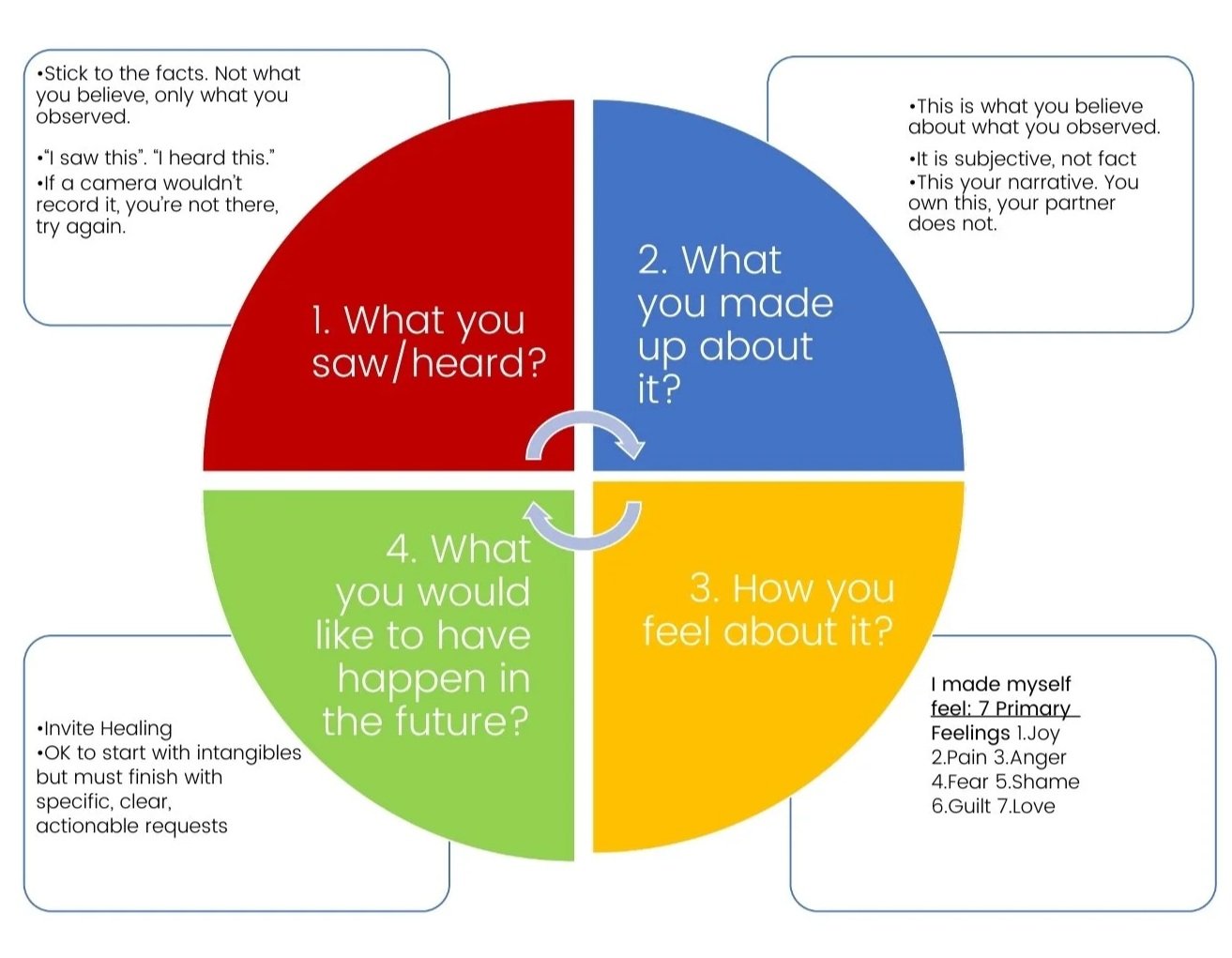
The Feedback Wheel visual as presented in Relational Life Therapy (RLT)
The Listener’s Role
Being the listener is the harder of the two roles. Especially if you’re prone to defensiveness.
Step 1: Mirror back what you heard
If you haven’t learned the Active Listening practice yet go there.
Step 2: Bring Empathay
If you haven’t learned the Empathetic Listening practice yet go there.
Step 3: Acknowledge, own and apologise for whatever you can
Step 4: Meet your partner’s requests where you can, and if you can’t offer an alternative.
That can require some advanced negotiation skills. If this all feels too dificult it would be worth seeking coaching support.
Note
This is an advanced tool that requires you to be able to regulate yourself in the heat of the moment. If you’re struggling to use it effectively get in touch to discuss coaching support.
Learning about these tools is one thing. Using them effectively when you're triggered, hurt, or convinced your partner is being completely unreasonable is another.
That's where working with a coach comes in.
In couples coaching we practise these skills together, with someone to help you catch your patterns in the moment and find your way back to each other.
If you'd like to explore what that could look like for you, check out my couples coaching page or book in a free discovery call.

Where to go Next?
Active Listening
If you keep interrupting each other or don’t feel like you’re really able to hear or understand each other

Empathetic Listening
If you’re getting stuck arguing over the details, or struggle to see things from their perspective.

Relational Check-In
If you’re struggling to find time for meaningful conversations, or feel like challenging processes are taking up too much time in your relationship.