The 5:1 Relationship Ratio: The Key to a Happy and Lasting Relationship
Hi, I’m Gaia Harvey Jackson - a couples coach trained in Relational Life Therapy, working with partners online and in Devon.
My husband and I don't celebrate Valentines day, and we never really have.
Why?
Because adoring each other on the daily is baked into our lifestyle.
Cherishing each other through physical affection, words of appreciation and doing kind or supportive things for each other regularly, not only makes our lives feel waaaaay sweeter, it's also a key indicator of whether or not a relationship will go the distance.
What is The 5:1 Relationship Ratio
Some years ago I learnt about the 5:1 ratio from the Gottman Institute (John and Julie Gottman are life partners and the leading researchers in what makes love last) and according to their research, couples need a balance of 5 positive experiences to every 1 negative experience for the relationship to feel sustainable and happy.
Let me just repeat that… 5:1 positive to negative!!!
For every snide remark, every criticism, every action that hurts our partner, we need 5 counter experiences of warmth, appreciation, or kind guesture for the relationship to feel in balance.
That's a lot of positive experiences, and I can tell you that for the first 3 years of my relationship that was definitely not the case. We've had our fair share of relational drama, broken trust, multi-day arguments, built-up resentment - the works.
But here's the thing - it's not the conflict that's the issue… it's how good we are at moving from conflict to repair, and how we tend to our love that is the deciding factor on whether your relationship will last or not.
In this blog post I'm going to share about why cherishing really matters, what doing conflict well looks like, what to do if your ratio is more like 1:5 in opposite balance, and at the end I offer a simple cherishing ritual to help you on the right track.
Before we really dig in I want to momentarily invite you into a place that is very special to my husband Ronan and I. A place that lives in our imaginations called the Peace Garden. It's where we are when everything in our relationship is flowing smoothly, the roses are in bloom and the trees are abundant with delicious ripe fruit. Like any garden, it has its seasons, sometimes verdant and bursting with life, other times in hibernation. We take a lot of care to do the weeding and pruning (truthful conversations), seeding, planting and watering (cherishing and quality time). It's a place we've diligently cultivated over the last 10 years, and what you're about to read are a few tips from our gardening manual.

Hand holding a set of scales demonstrating the 5:1 Relationship Ratio from the Gottman Institute
Why the 5:1 Ratio Matters: Building Your Buffer
Think of a set of scales. Intentionally cherishing your partner every day through small acts like a long hug, or a meaningful compliment, is like putting small beans on one side of the scales. The more you put on, the more it builds up, it gathers weight. Then when something challenging comes along, even a pretty big rupture, it may tilt the scales, but the counterweight of all those beautiful beans you've been stacking up keep things from escalating out of control.
Now imagine what happens to those scales when something comes along and there's no beans of cherishing balancing things out. Even small things can tip the scales, and big things may lead you to question the relationship entirely. It's harder to remember in the moment why you're together if you don't have a recent bank of cherishing memories to draw on.
Learning how to do conflict well actually requires us to learn a whole new skill set (which I'll touch on below). And something I've learned with time is that intentionally cherishing and appreciating each other builds up a buffer of love that works alongside those repair skills. When something gnarly comes along, we're much more able to withstand the discomfort of it. We still feel the pain, but it doesn't cut as deep. It's easier to remember that we love each other, and that the pain is worth it, because there's so much good.
Why We Don't Cherish
We're not in control of when ruptures happen. To some degree, there will always be tensions or disagreements in your relationship, because we're different people. We have different needs and desires, and navigating those is like charting a sail boat across open water - it's a skill that requires cooperation, adjusting course, and it can get pretty hairy at times.
What is within our control, is how much we tend to our relationship. There can be many reasons that we don't cherish.
The easiest one to fall into is the complacency trap. Sometimes it's like a check box - partner, tick, now on to the other parts of my life that need my attention (I've certainly been guilty of that in past relationships). We take our partner for granted - expecting them to always be there, and because we feel so comfortable in their company, we often treat them much worse than our friends or colleagues (because they'll still love us no matter what - right?). This is when the Peace Garden starts to look a bit neglected - the roses need deadheading, the fruit trees need pruning, but we're too busy to notice.
Other times it can be that there's so much resentment built up between you, your hearts have hardened, and it feels too difficult or scary to let them back in, or it's even a kind of punishment to get back at them. The weeds have taken over the Peace Garden, and you're both stubbornly waiting for the other to get out there and do something about it. You can't even remember what the roses smell like.
What If You're Starting From a Deficit?
Maybe you're reading this and thinking "we're nowhere near 5:1 - we're probably at 1:5 the wrong way round. Is it too late?"
Here's what I know: Ronan and I spent a good two to three years in deficit. Years of broken trust, resentment, and ruptures that lasted for days. The scales were heavily tipped towards the negative. And yet, here we are now, celebrating our 10 year anniversary and more in love than ever.
The way back doesn't happen overnight, but it starts with a single bean. Then another. Then another.
You don't need to fix everything at once. You don't need to resolve all the resentment before you start cherishing. In fact, trying to do that often keeps couples stuck. What works is this: start adding small positive experiences while also addressing the issues that need repair. You can work on both at the same time.
Can you find one thing to appreciate about your partner today? Can you offer one small kindness, even while you're still angry? Can you look for one thing they're trying to do, even if it's not enough yet?
I'm not asking you to fake it or pretend everything is fine. I'm inviting you to add one bean to the scales, even when it feels hard. Then tomorrow, add another. The cumulative effect is real, and it creates the conditions for deeper repair to become possible, because our partners are much more receptive to our feedback when we're also seeing the best in them, not just the worst.
If there's active abuse, contempt, betrayal, or you've been looping round the same problems with no resolve, then cherishing alone won't fix that - couples therapy, coaching or marriage counselling can provide the professional support you need. But for most couples who've drifted into deficit, the path back is paved with small, intentional acts of love, whilst working on the parts that are hard.
If you're feeling stuck and need support navigating your way back, I'd love to help. I offer online couples coaching, as well as in person, to help partners rebuild connection and create the relationship they truly want. [Learn more about working together →]
What Cherishing Actually Looks Like in Your Relationship
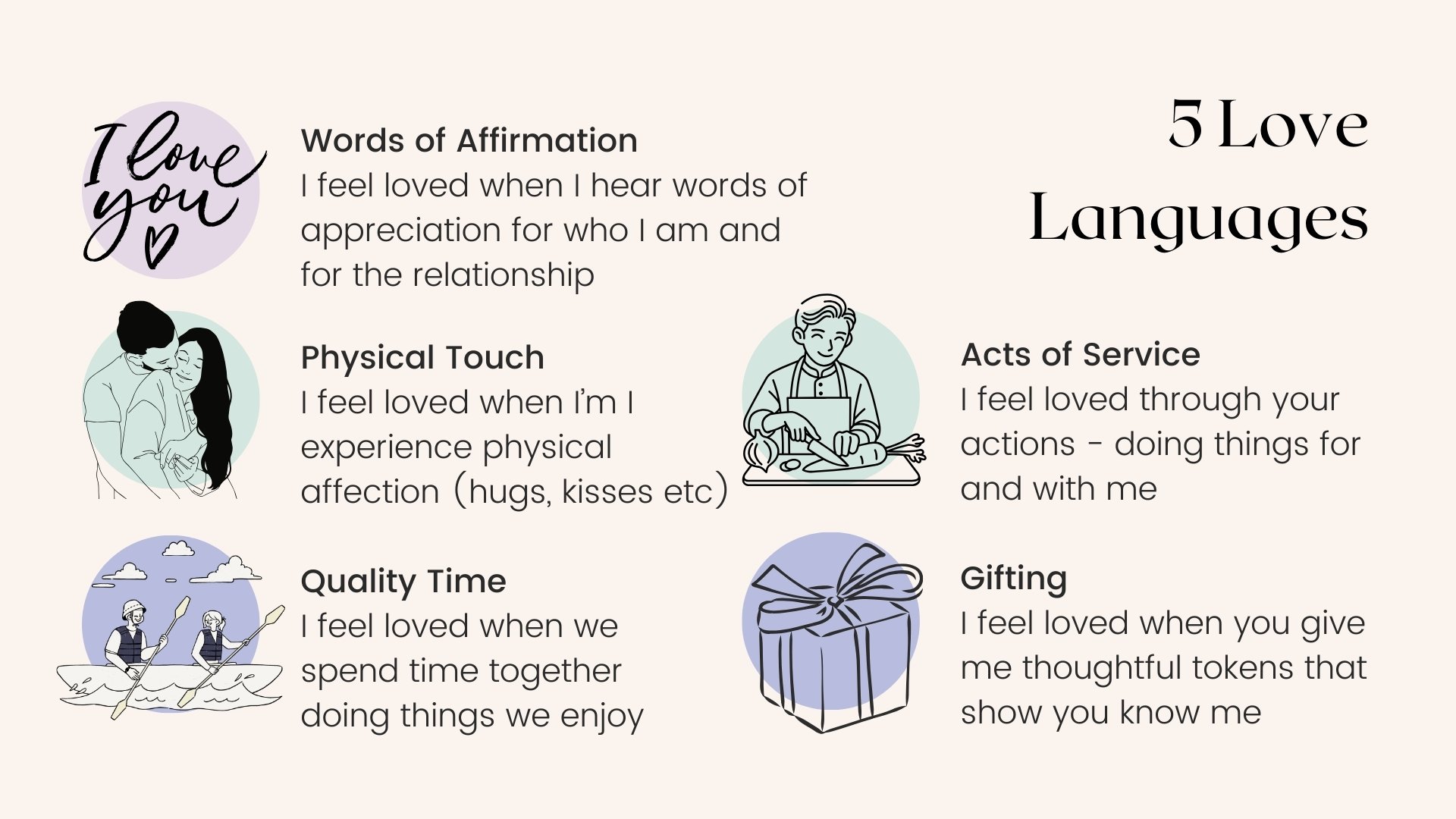
Image showing the 5 love languages from Gary Chapman
Understanding Love Languages
Cherishing can look like many things, and I love Gary Chapman's Love Languages as a framework to understand the ways that each of us need to be loved, in order to feel loved.
An example of this… I'm a physical touch kinda gal… you can give me all the gifts in the world, but if I don't get a morning cuddle, or a goodnight kiss I'll feel sad and lonely. Touch isn't really a big deal for Ronan, he's had to learn over the years how much this means to me. In his world, it's acts of service - I can shower him in strokes and kisses, which he likes, but it's not the same as when I take the time to make him a really good meal - one that's lovingly prepared and caters for all his dietary needs, he feels my dedication, his heart opens and the love between us flows effortlessly…
We're all different, and often times just understanding that we have a love language gap can make a huge difference in making steps towards building that buffer of cherishing. A love language gap isn’t a sign of incompatibility, it’s a call to understand each other better, which requires some communication.
Sometimes we need to spell it out for our partners, especially when our love languages don't match. I once sat down with Ronan and wrote out a list of 5 specific and easy to action examples of what love looks and feels like to me. Giving me a hug from behind when I'm washing up. Looking into my eyes for a few minutes before bed. Taking 10 minutes before work to sit with a cup of tea with no screen distraction. This is how we can help our partners win. Help them give you the love you want… otherwise how on earth are they supposed to know?
We all want prince or princess charming to know and cater for our every need - but that's a fantasy. People are not mind readers - you can sit around complaining that you're not getting what you want, or you can give your partner the instruction manual. It's really up to you!
Small Acts, Big Impact
Here's what cherishing looks like in practice: giving each other hugs where you relax into them, saying I love you on a daily basis, noticing and appreciating the things our partner does for us, making time to go for a long walk together and hear about what's on their heart, looking into each other's eyes and saying goodnight before bed.
These are all relatively small acts, that don't take much time, or cost any money. They're easy wins!
And what happens is cumulative… the more of these positive experiences we add to the bank, the more beans we stack on those scales, the easier it is to withstand the ruptures or the tricky parts.
In my couples coaching practice, partners often come to the first session ready to launch into all the problems. And of course, those are important to address, but what many couples fail to notice are all the positive things that happened that week, and the ways that their partners are really trying.
A few months ago in my couples coaching work, I was seeing a couple who were struggling to save up enough to buy a house because he'd been out of work for a while. I could see him getting frustrated and defensive. When I asked his partner to tell me about all the things that he had been doing towards this goal I saw his whole body soften - he no longer needed to defend himself. Maybe he wasn't contributing totally the way his partner wanted him to, but he was being recognised for all the effort he had been making. We went from tense and icy, to warm and compassionate in a matter of minutes. I could also see her soften, as she expanded her focus to include what he was doing, not just honing in on how he wasn't doing enough.
A phrase I love from Terry Real, founder of Relational Life Therapy, is to “celebrate the glass 15% full” - when you start getting what you want - acknowledge it! It’s far more motivating to your partner to keep going in that direction, rather than always feeling like it’s not enough. That’s a real demotivator.
Some of the biggest breakthrough sessions I've had have been in focusing on what's been going well, and seeing how each partner lights up and softens when they get acknowledged and praised for their efforts.
It sounds simple - and that's actually the beauty of this advice. It just requires the intention to do it.
Cherishing is its own reward, and the more we do it, the more we want to do it, because it feels so damn good.
When Conflict Comes - How the Buffer Helps
Moving between harmony and disharmony is a natural part of relating. Learning how to repair from rupture is a skill in itself - you can absolutely learn to do conflict well without a buffer of cherishing. But when you have both the repair skills AND the buffer? That's when things get easier.
Here's what I mean.
Last week Ronan and I got into a heated discussion about money, a very triggering topic for me. In the past things would have escalated, I would have felt wobbly, started crying and then got angry, running with the story "he doesn't care about me." I'm a fighter, and I would have fought. But because of the last few months where he's been bringing me tea and cuddles in bed most mornings, and telling me how much I mean to him, that old narrative of "he doesn't care about me" just doesn't stand up. We moved through the conversation, found a place of resolution and came back into a loving place, whereas once that kind of altercation could have rippled out for days.
The buffer didn't prevent the rough waters - those are inevitable when you're charting a sailboat together across open water. And it didn't give me magical repair skills I didn't have before, that's its own journey, and one well worth taking. But it gave us a foundation to work from. That old story of "he doesn't care" simply couldn't take hold when I had months of evidence to the contrary.
Here's what good repair looks like in relationship therapy and couples coaching, whether you have a buffer or not:
We move away from blame, defensiveness or being right, and instead bring curiosity and a desire to understand
We take turns to speak and listen, acknowledging the other's experience so both of you feel seen, heard and understood
Apologies are made and responsibility is taken where appropriate. (And no, not every issue is 50/50)
Steps are taken towards making amends which may include making requests, setting limits or seeking external support to address stuck issues
We remember we love each other, and are able to forgive, move on, and return to a place of softness and affection - we find our way back to the Peace Garden
These repair skills can be learned and practiced regardless of how much cherishing you've been doing. But here's what the buffer gives you: it makes the repair process feel less fragile. Without those beans on the scales, getting to curiosity and understanding takes more effort, more intentionality. With the buffer, there's something solid to stand on - a recent history of love that helps you remember why you're fighting for the relationship, not just fighting.

Image showing a couple holding hands for a cherishing ritual
Your First Step - A Simple Cherishing Ritual
As well as regular cherishing throughout the day, it can also be beautiful to create more intention and structure for it, so your peace garden can bloom.
This weekly cherishing ritual is something I teach in my couples coaching practice, and it's been transformative for many partners.
Here's a suggestion for a simple cherishing ritual you can do with your partner:
Create time once a week where you can be alone for at least 15 minutes. If you have kids then doing this before bed can work well.
Sit opposite each other, hold hands and look into each other’s eyes with soft loving attention.
Take turns to give each other 3 appreciations:
Something you love about their body - it could be: I love the shape of your lips, and the way your eyes light up when you smile. Or: I love the feel of your arms around me at night - I feel so secure and at peace. Or: the way your bum looked in those jeans today really turned me on.
A quality you appreciate - For example: I love how kind and patient you are, the way you took the time to be with our son today when he was upset really touched me. Or: I love how spontaneous you are, and the way you get me to try new experiences. Or: I love that we can sit together in silence and that I can be fully myself around you.
Something they've done that you've benefitted from - Ideally within that last week. E.g. thank you for taking the kids to school this morning when it was my turn and letting me stay in bed because you knew I was tired. Or thank you for coming with me to my doctors appointment, I was feeling a bit nervous and I felt so much calmer having you there to steady me, or even: thank you for consistently watering all the plants. It's so wonderful to be surrounded by beauty every day.
Tip: Let it be ordinary, everyday things. Even if you've agreed who takes out the bins and who waters the plants, you can still take the time to acknowledge it and appreciate it. You can also say the same things over and over, you don't need to invent the wheel - just say what's true in the moment.
Trust me on this one… regular praise goes a really long way.
The Peace Garden doesn't tend itself - but with a little daily attention, the roses bloom, the fruit ripens, and you get to enjoy the sweetness of it together.
Common Questions About the 5:1 Ratio and Relationship Health
-
Building the buffer happens gradually. Some couples notice shifts within weeks of daily cherishing, while others take months. In my couples coaching work, I've found that consistency matters more than speed - small daily acts compound over time. Even if you start with just one act of appreciation per day, you're already shifting the ratio in a positive direction.
-
If you're in deficit, the 5:1 ratio can help rebuild your foundation alongside learning conflict resolution skills. In relationship therapy and couples coaching, combining cherishing practices with repair skills gives partners the best chance at reconnection. If you're dealing with abuse, contempt, deep betrayal, or patterns that keep repeating with no resolution, professional support through marriage counselling or couples therapy is essential.
-
Any moment of appreciation, affection, or connection counts: a genuine compliment, a long hug, making your partner's favourite meal, asking about their day and really listening, a loving text message, saying "I love you" meaningfully, or simply making eye contact and smiling. The key is that it feels positive and connecting to both of you.
-
Both can help strengthen relationships, but they have different focuses. Couples therapy often addresses deeper issues, past trauma, and entrenched patterns, while couples coaching tends to be more skill-focused and forward-looking. As a couples coach trained in Relational Life Therapy, my practice bridges to two. I help partners develop practical tools for communication, conflict resolution, and building intimacy, and do the necessary therapeutic work to deal with the parts of you that don’t want to use them. Many couples find that coaching gives them the support they need to create lasting change.
-
Yes, I work with couples online as well as in person. Online couples coaching can be just as effective and offers more flexibility for busy schedules. We'll focus on building your cherishing practices, developing repair skills, and creating the deeply connected relationship you want. [Learn more about online couples coaching →]
Ready to Strengthen Your Relationship?
So while the world is scrambling for Valentine's reservations and overpriced roses, Ronan and I will be doing what we do every day - bringing each other tea in bed (well, ok - he’s the one mostly bringing the tea!), giving each other a kiss when we enter the house, noticing and appreciating the domestic chores getting done. Because we've learned that love isn't built on a single day - it's built in the small beans we add to the scales, every single day.
If this post resonated and you're ready to build a stronger relationship with professional guidance, I'd love to support you. I offer online couples coaching for partners who want to move from disconnection to deep intimacy, using practical tools grounded in Relational Life Therapy.
Whether you're dealing with recurring conflict, feeling like roommates, or simply want to strengthen an already good relationship, I can help you create the cherishing, connected partnership you both deserve.
[Book a free consultation →] | [Learn more about couples coaching →]

About Me
I'm a couples coach trained in Relational Life Therapy (RLT), working with partners and individuals online and in my Devon practice. I've spent the last 3 years helping couples rebuild trust, improve communication, and create the deeply connected relationships they long for.
My approach combines neuroscience backed trauma work, and practical, doable skills that actually work. I believe every relationship has the potential for transformation - sometimes you just need the right tools and support to get there.
If you want professional and practical help to navigate conflict or resentment, and create a relationship filled with cherishing and joy I’d love to hear from you. [Book a free consultation →]